

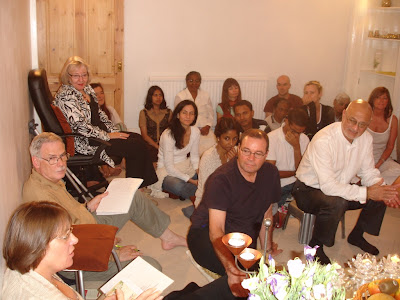


Venerable Rewatha introduced the Venerable Dhammavihari briefly, with obvious delight that he had taken up a long-standing, repeated invitation. Our Temple monk knew that Glasgow would benefit from his many years of living and teaching the Buddhist way. In Toronto Professor Dhammavihari had taught keen Western students the essence of Buddhism. Later he went on to write several books.
Addressing us as “dear brothers and sisters” the Venerable Dhammavihari supported our desire for “happiness” by following the enlightened one. He spoke to us of one whom he affectionately called “my Buddha” – the Buddha of history, not of legend and one whom he seemed to know intimately. His message was thoroughly down to earth – practical and non-religious (in the Western sense). Buddha, he insisted several times, was a man – not divine. Responsible action, not supplication, is the Buddhist way. The Buddha’s extraordinary qualities (such as his childhood wisdom) could be explained by passing on what he had gathered before his birth. This was “scientific”– within natural laws- not “miraculous”. Science has demonstrated that the foetal brain is already preconditioned.
Most of his talk focused on how traditional Buddhist morality is legitimised by its realism, and how we might realistically implement it.
He told us that he had been a householder, but became a monk (a similarity with the one he follows)- leaving family life in order to walk the way wholeheartedly. He joked that his life seemed to follow 34 year cycles, and perhaps it’s time that he become a householder again. His wide-ranging talk included responses to the questions and comments from his hearers, and sharing from both the Buddha’s story and his own. But a clear theme emerged. The message that he travelled from Manchester to leave with us was, “Buddhism works, if we work it. The Enlightened One has shown us how to live wholesome lives and thereby find happiness for ourselves, seeking happiness for all. Perhaps the best place to start living the Buddha’s way is to learn restraint.”
The morality he urged was not only for personal happiness, but for the happiness of all. By practicing the five precepts we help to better ourselves and the world about us. His examples were rooted in a knowledge of the seeming ambiguities of life as we live it. For example “No sexual misconduct” was discussed in terms of adultery between two consenting adults. They should realise what seemed to give them happiness destroyed the happiness of others and shattered social stability.
The cutting edge of his message was restraint: ‘In my childhood the essence of education was “The 3 Rs” of Reading ‘Riting and ‘Rithmatic. Today I want to stress the need for three different Rs – the Three Rs of Self-reform: Restraint, Responsibility and Readiness to learn!”
All that the Buddha taught was to help us enjoy life. Life is meant to be enjoyed, and this happens when we are responsible to ourselves and others.
An example is, “No intoxication”. This keeps our minds clear, and prevents us from making many ills (mental, social and physical). It’s easy to see how restraint in this area, if widely practiced would, cure many social problems. Individual restrain may not change “the world”, but it will change ourselves and our circle of influence – spreading a great amount of good.
Restraint can be best learned by small steps, not heroic leaps. Restraint in eating, for example, might well begin by shifting the major meal from evening to noon. Once that becomes habitual, it will be easier to abandon the evening meal. Sexual relations within marriage can be restrained for a time, and then enjoyed again. It’s all part of the training in self-restraint, which becomes a great strength for self-development.
Professor Dhammavihari shared a few insights from his years of practice, sometimes phrased in generalizations:
• Put yourself in the other person’s position when you relate to others;
• The joys of not possessing are far greater than the joys of possessing; a life of restraint, with carefully reduced needs, paradoxically leads to a richer life. The fruits of grasping are a pauper’s life.
• It is hard to have forgiveness for those tormenting you, but it is the happier way.
On this last point he recalled Jesus’ dying word for his tormentors – “Father forgive them for they don’t know what they are doing…” “See” he said, “We recognise truth and wisdom from wherever we find it.”
I responding to a question about Karma – how to move towards Nirvana, our guest said the focus should be good actions. What happens in our head (cognition) is at three levels:
• First, the senses receive something (perception).
• Then we react to it (feeling).
• The we act.
• Attending to all three levels carefully and responsibly will lead to good actions.
Good actions develop better character, and lead us on.
Dennis Oliver


